
Beyond Hiring: Using Agentic AI Automation to Break the Turnover Loop in Restaurants
The Restaurant Labor Crunch Isn’t “Just Staffing”—It’s an Operating Model Problem
If you run a restaurant, you already feel it: fewer applicants, more no-shows, constant retraining, and a team that’s one bad Saturday away from burnout. The industry’s labor shortage and high turnover aren’t separate problems—they reinforce each other, creating a loop where short staffing worsens working conditions, which then drives more resignations. (Reiner, 2025; NetSuite, 2024)
To break that loop, restaurants need more than hiring posters and signing bonuses. They need a better system—one that protects the guest experience while reducing the everyday friction that makes good people quit. That’s where agentic AI automation workflows—AI systems that can coordinate tasks across tools, teams, and touchpoints—become more than “tech.” They become a practical retention strategy.
What’s Actually Driving the Shortage (and Why It’s Not Going Away by Itself)
1) Turnover costs compound fast.
Replacing people isn’t just “finding someone new.” It’s recruiting time, onboarding, training, and lost productivity—repeated over and over. Restaurants already operate on thin margins, so the drag from constant churn is especially punishing. (Campbell & Foster, 2024)
2) The job is high-pressure—and increasingly out of balance.
Restaurants are inherently intense. But when teams are understaffed, remaining employees become overtasked: more side work, more simultaneous transactions, more stress, less control. That accelerates burnout and exits. (Stoyanov, 2025; Reiner, 2025)

3) External pressures are tightening the labor pool.
In some markets, immigration enforcement and policy shifts can disrupt staffing—especially in cities and segments that rely heavily on immigrant labor. (Desmond, 2025; Stacey, 2025)
4) Workers expect “real jobs,” not just shifts.
More restaurants are responding with benefits, clearer career paths, and scheduling predictability—because workers increasingly compare restaurant roles to other industries that offer stability. (Paradis, 2025; Upson, 2024)
What Leading Operators Are Doing Differently (Hint: It’s Not Just Pay)
Across the market, you’ll see a consistent playbook:
Benefits and long-term incentives (retirement plans, paid leave, healthcare subsidies, tuition support) to reduce the “temporary job” mindset. (Paradis, 2025)
Culture and fairness systems (clear expectations, better manager training, workload smoothing). (Reiner, 2025)
Perks that signal respect—profit sharing, discounts, sabbaticals, and structured development pathways. (Greggs, n.d.; Nando’s, n.d.; wagamama, n.d.; The Times and The Sunday Times, 2025)
These approaches work—but they also create a new challenge: they add administrative overhead (more scheduling complexity, more HR coordination, more communication). That’s where agentic AI workflows become the missing “glue.”
Where Agentic AI Automation Workflows Fit (and Why They Help Retention)
Most restaurants don’t lose people because they hate hospitality. They lose people because the day-to-day experience is chaotic: unclear schedules, constant interruptions, repetitive admin, and operational firefighting.
Agentic AI workflows reduce that chaos by automating the busywork and orchestrating the handoffs across recruiting, scheduling, training, ordering, and shift execution.
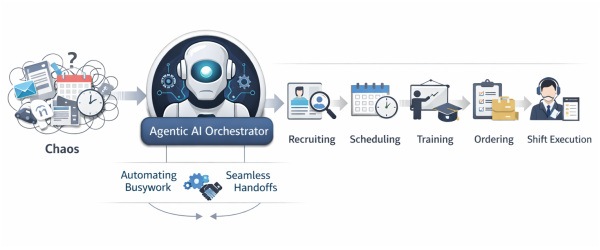
1) Recruiting and Hiring: Faster, Consistent, Less Manager Time
Some operators are already using AI to speed up screening, scheduling interviews, and sending offers—reducing the time-to-hire dramatically. (Paradis, 2025)
What agentic workflows add:
An AI “hiring agent” that can:
pull applicants from job boards,
text candidates,
schedule interviews,
remind managers,
trigger background checks/onboarding tasks,
send out proposals/contracts,
and update your ATS automatically.
This matters because hiring delays aren’t neutral—they overload the team you already have.
2) Scheduling: Fewer No-Shows, More Predictability, Less Drama
Scheduling software helps, but agentic automation goes further by coordinating decisions:
forecasting volume,
recommending staffing levels,
suggesting swaps,
alerting when coverage risk rises,
and pushing confirmations to employees.
That predictability is a retention lever—especially for workers balancing multiple jobs. (Paradis, 2025; Talos360, 2025)
3) Training and Onboarding: Make Competence Faster (and Less Painful)
Weak onboarding creates early exits. Strong onboarding builds confidence and momentum—especially in the first 30–90 days, when attrition is often highest. (Institute of Hospitality, 2024)
Agentic workflows can:
assign role-based micro-training,
deliver checklists by station,
confirm completion,
notify a shift lead to observe a skill,
and log progress—without managers chasing paperwork.
4) Front-of-House Load: Let Tech Absorb the Interruptions
Phone calls, order-taking, and repetitive questions pull staff away from the guests in front of them. Voice AI and automation are increasingly positioned as tools to relieve that burden and reduce stress. (Stoyanov, 2025)
Similarly, some restaurants reduce staffing strain by outsourcing/automating phone ordering and operational tasks. (Tarro, 2025)
Agentic workflows connect the dots:
When voice ordering spikes, the system can:
update prep priorities,
alert kitchen capacity constraints,
adjust promised pickup times,
and notify a manager—before the shift becomes a breakdown.
A Practical Map: Pain Points → Agentic Workflow Fixes

The Real Takeaway
The restaurant labor shortage isn’t only a hiring problem—it’s a retention-and-work-design problem. Better pay and perks help, but they aren’t enough if the work still feels chaotic.
Agentic AI automation workflows are compelling because they attack the hidden driver of churn: friction. They reduce manager admin, smooth schedules, remove repetitive tasks from the floor, and make training consistent—so your team can focus on hospitality (and go home less exhausted).
If you’re trying to retain great people in 2026, the question isn’t “Should we use AI?”
It’s: Which parts of our operating model are still running on manual stress—and what would happen if we automated the stress away?
References
Campbell, B., & Foster, D. (2024, April 10). How labor shortages are affecting your restaurant’s profits. Baker Tilly. https://www.bakertilly.com/insights/labor-shortages-affecting-restaurant-profits
Carman, T., Rojas, W., & Gathright, J. (2025, May 14). After ICE visits, D.C. restaurants fear labor shortage. The Washington Post. https://www.washingtonpost.com/food/2025/05/14/dc-immigrant-ice-restaurants-labor/
Greggs. (n.d.). Rewarding you. Retrieved January 15, 2026, from https://careers.greggs.co.uk/rewarding-you
Institute of Hospitality. (2024, April). Cost of living crisis: Changes to the hospitality industry landscape, customer demands and trends [PDF]. https://www.instituteofhospitality.org/wp-content/uploads/2024/04/Cost_of_Living_April_2024.pdf
Nando’s. (n.d.). We’ve won awards for being a great place to work. Retrieved January 15, 2026, from https://nandos.careers/why-nandos/index.html
Paradis, T. (2025, May 16). Paid leave, bonuses, and 401(k)s: How some restaurants are tackling staffing shortages. Business Insider. https://www.businessinsider.com/restaurants-taking-steps-to-attract-and-keep-workers-hiring-2025-5
Reiner, A. (2025, March 14). Five years after COVID, the restaurant labor market has yet to recover. Eater. https://www.eater.com/24385730/restaurant-job-market-covid-pandemic-effects
Schwarz, L. (2024, December 17). The shortage of restaurant workers in 2025. NetSuite. https://www.netsuite.com/portal/resource/articles/human-resources/restaurant-labor-shortage.shtml
Stacey, S. (2025, June 8). Donald Trump’s immigration restrictions threaten restaurant labour shortage. Financial Times. https://www.ft.com/content/9a54216c-4e06-40d7-8352-19aeed366803
Stoyanov, S. (2025, February 10). Restaurant labor trends 2025: Rising wages drive need for retention, AI. SoundHound AI. https://www.soundhound.com/voice-ai-blog/restaurant-labor-trends-2025-rising-wages-drive-need-for-retention-ai/
Talos360. (2025, June 4). How to improve hospitality staff retention. https://talos360.co.uk/resources/improve-hospitality-staff-retention/
Tarro. (2025, February 6). Restaurant labor shortage: How to thrive with limited staff. https://www.tarro.com/articles-guides/restaurant-labor-shortage
The Times and The Sunday Times. (2025, May 23). 26 best very big places to work 2025. https://www.thetimes.com/best-places-to-work/very-big-companies/article/best-very-big-companies-uk-2025-tdbnxnk50
Upson, M. (2024, January 23). Restaurants with some of the highest employee retention rates. EMERGING. https://emerging.com/insights/employee-hiring/restaurants-with-some-of-the-highest-employee-retention-rates
wagamama. (n.d.). Noodle+. Retrieved January 15, 2026, from https://www.wagamama.com/benefits
🚀 Ready to Break the Turnover Loop?
The restaurant labor crisis isn’t going away—and “just hire harder” won’t fix an operating model that burns people out. The good news? You can redesign the work.
Start small. Pick one friction point—forecasting, scheduling, confirmations, swaps, or training—and build an agentic AI workflow that removes the chaos, protects your team, and stabilizes service.
Don’t just upgrade your tools. Upgrade your operating system.
Experiment. Automate the busywork. Empower your managers. Keep your best people longer.
👉 Want help mapping your first agentic workflow? Let’s design a 30-day pilot that delivers measurable retention and labor-efficiency gains.
Enquiries at: [email protected], or book a Free Call here.